

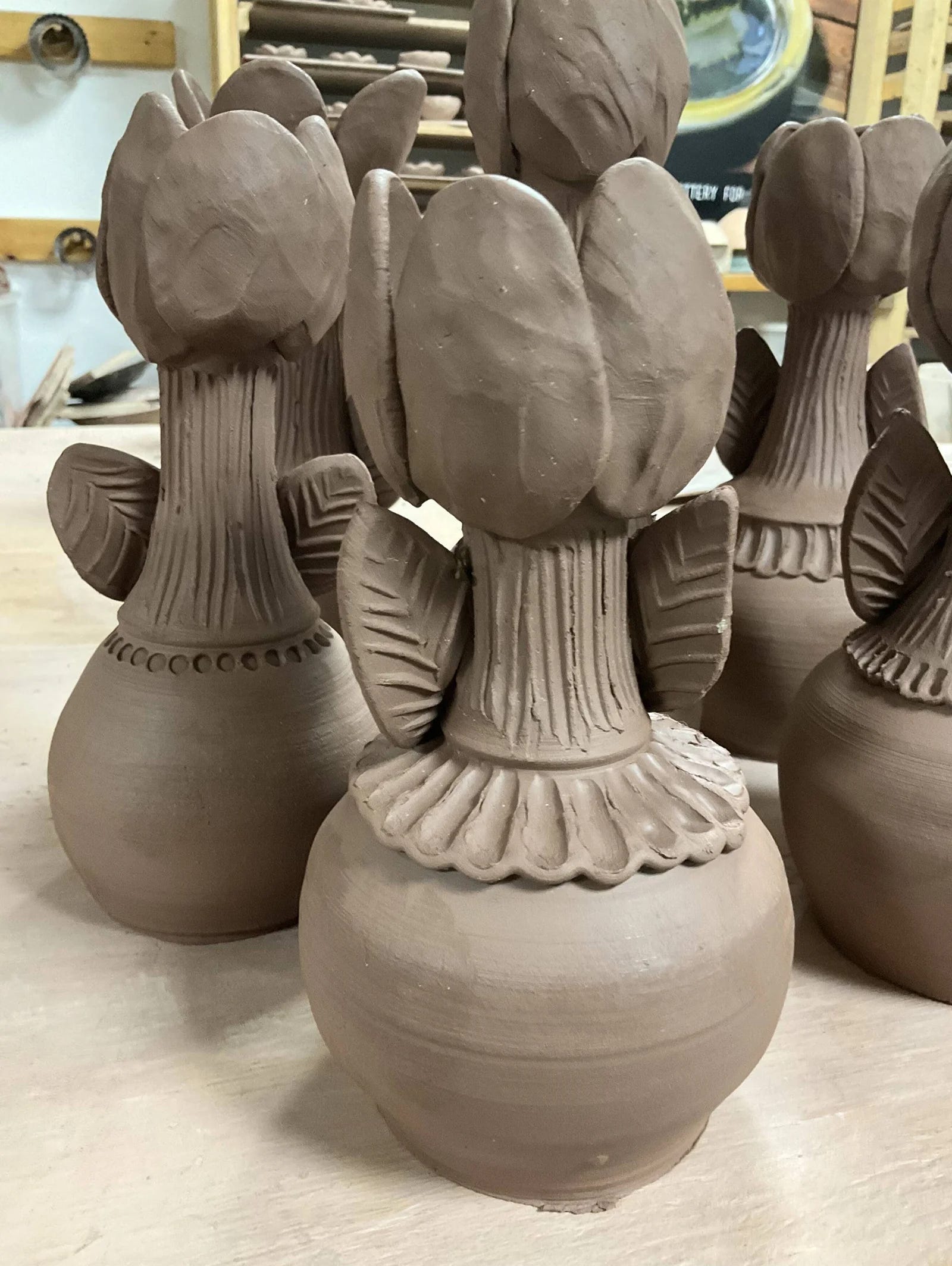
In 1999, I took a leap of faith and started my own pottery business. I worked on my porch and in my utility room with a pitiful-looking Skutt 1027 kiln, a board stretched across my washer and dryer, and a small worktable—nothing more. I had no wheel. My tools were simple: a rolling pin, a few ribs, a wire cutter, buckets for reclaim, and whatever hand tools I could afford at the time. I had already decided that I wanted to do this with as little help as possible from my grandparents. I needed to find my own style, my own way, my own voice in the work.
I needed to let the work take shape through my hands, not someone else’s, learning and growing through mistakes along the way. I outgrew that space in a matter of months. When it became clear I needed room to continue, my dad built me a small studio in his backyard. Within a year of that, my grandmother became ill with Alzheimer’s. My granddad was suddenly trying to care for her while still running Peppertown Pottery—something that was nearly impossible to sustain. He eventually asked me to move my business there and take on the responsibility of running both his operation and my own.
Moving my work to Peppertown Pottery also meant working inside someone else’s name. I was known as the granddaughter. People knew there was a granddaughter helping with the work, but they did not know my name. My pots were handled in the shadow of a legacy that was not mine, and I struggled to step out from under that without rejecting the place that had formed me.
“I learned to carry the weight of another name while quietly earning my own.”
I learned from that season. Working inside someone else’s name taught me patience and discipline. It forced me to pay attention to the work itself rather than recognition, to consistency rather than visibility. I learned that a reputation cannot be rushed and that good work has to be done long before it is noticed. That discipline—showing up, doing the work, and letting it speak in its own time—became foundational to how I work and how I measure success.
My name did matter to me. I worked hard to make pieces that were different—work that reflected my hand, my instincts, and my way of seeing form. I wanted the work to be recognizable as mine. At first, I named my business Clay Art and worked under that name for a short time. But gradually, without planning it, people stopped using the business name and began referring to the work simply as Tab. That shift mattered—not because it marked success, but because it told me the work had begun to speak clearly enough to be identified with me.
Being recognized by name pushed me to be bolder and more distinctive in my work. By then, the habits were already formed—patience, room to move within the work, and attention to form and detail. Boldness meant clarity and intention. The work had been shaped slowly, long before it carried my name, and that foundation still holds.